
The E-moto Problem: What Northfield Can Already Do About It
Police Chief Schroepfer confirms current state law already bans e-motos on sidewalks and trails. He's choosing education over enforcement for now

Last week I emailed Northfield Police Chief Jeff Schroepfer about the safety issue posed by e-motos on city sidewalks, parks, and trails. See my email in footnote1.
A quick distinction, since terms get used interchangeably and that’s part of the problem. An e-bike has working pedals and, under Minnesota law, is limited to 750 watts and 28 miles per hour. An e-moto can look like a minibike for the street or a motorcycle for the dirt.
Some e-motos have no pedals at all. Many can quickly accelerate to 30 or more miles per hour on throttle power. Legally, Minnesota treats them like electric motorcycles and mopeds: registration, a license or permit, and no riding on sidewalks or bicycle trails.
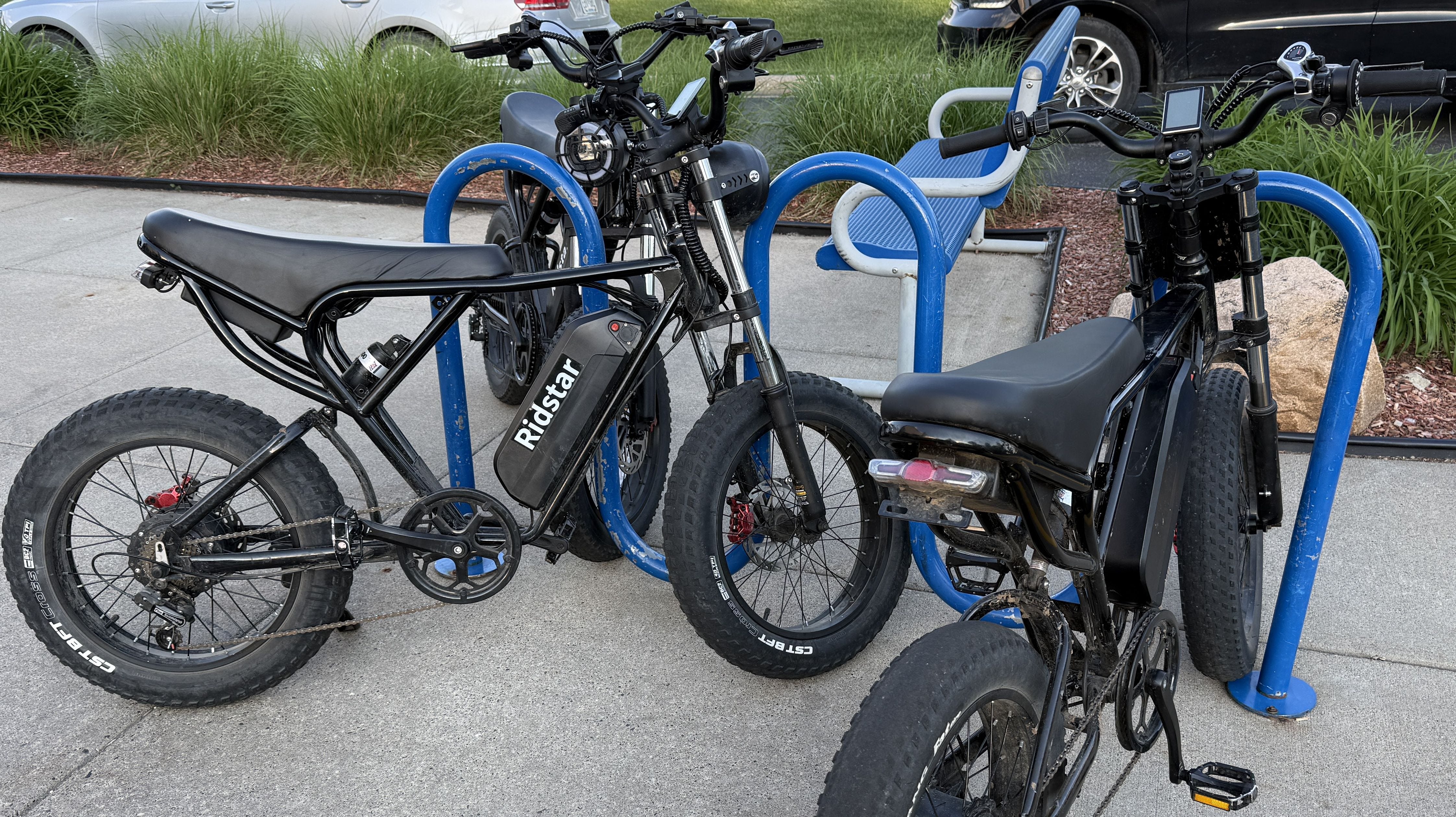
The gap between the two categories isn’t an accident. According to the Bicycle Alliance of Minnesota (BikeMN), the bicycle advocacy group tracking this issue statewide, 750 watts is roughly equal to one horsepower, about what a healthy adult cyclist can produce at peak effort for a short burst. A legal e-bike motor is designed to assist human power, not replace it with something categorically more powerful. There’s no comparable national legal definition for an e-moto, which gives manufacturers room to put pedals on what is functionally an electric motorcycle, market it as an e-bike, and sell it online to anyone with a credit card, including minors.
BikeMN has been pushing back hard on media coverage that blurs this line, arguing that “’we don’t have a word for what it is’ is not the same as ‘it must be what the police report said.’” Their point: calling an e-moto an e-bike doesn’t just cause confusion, it obscures who’s actually responsible when something goes wrong, and it fuels calls to restrict legal e-bikes for a danger those bikes don’t pose.
What's At Stake
On August 12, 2024, Janet Stotko was walking near 15th Street West in Hastings when she was struck from behind by a 14-year-old riding at 25 miles per hour. She suffered a traumatic brain injury, a blown eardrum, broken bones in her face and skull, severed nerves, and a brain bleed. She spent two days on a ventilator and three weeks in the hospital. She will never taste or smell again.
Early police reports and national wire coverage described the device as an “electric bicycle.” According to BikeMN’s Erik Noonan, who tracked down the make and model, it was a Movcan V60, an electric motorcycle with a 1,500-watt peak motor and a top speed over 30 miles per hour, capable of full throttle at any speed. Under Minnesota law, that device was illegal on any sidewalk, trail, or road before it ever left the store. The 14-year-old riding it was below the minimum age to operate even a legal e-bike, and had no license.
The rider's age, the vehicle involved, and where it was being operated were all already prohibited under Minnesota law. Nothing about it required new legislation to prevent. It required enforcement of rules that already existed.
NPD's Approach: Education First
The Chief’s initial reply indicated that the department was aware of the problem and preferred to emphasize education, since most e-moto riders are juveniles and their parents don’t realize that e-motos are different from e-bikes. The department says it will cite unsafe riders when appropriate but is not making routine citation of e-moto violations its primary strategy.

The Chief described education as the department's primary approach. The one concrete example he provided was a brochure the department produced last year about e-bikes and e-scooters. It doesn't mention e-motos, the vehicles at the center of the concerns he described.
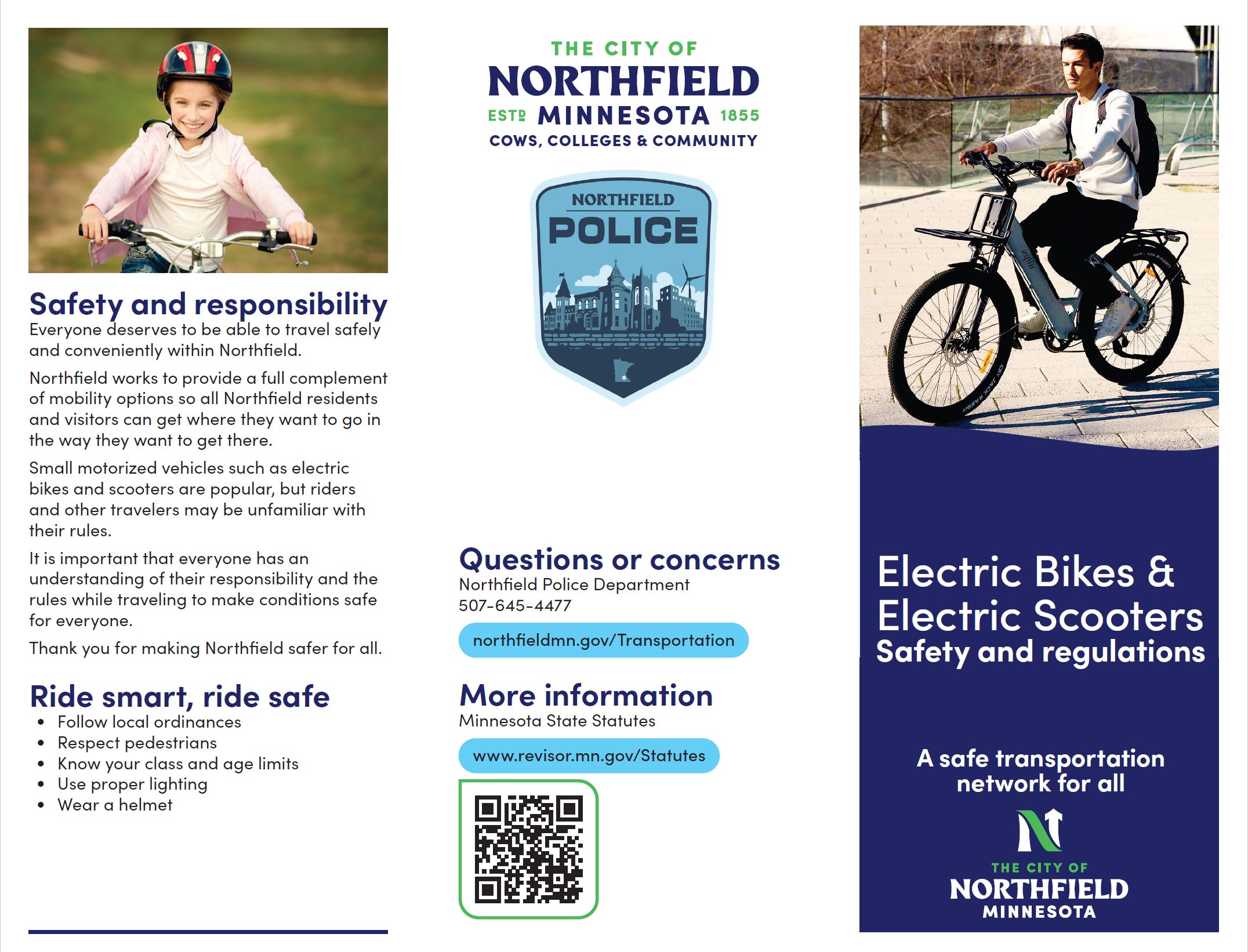
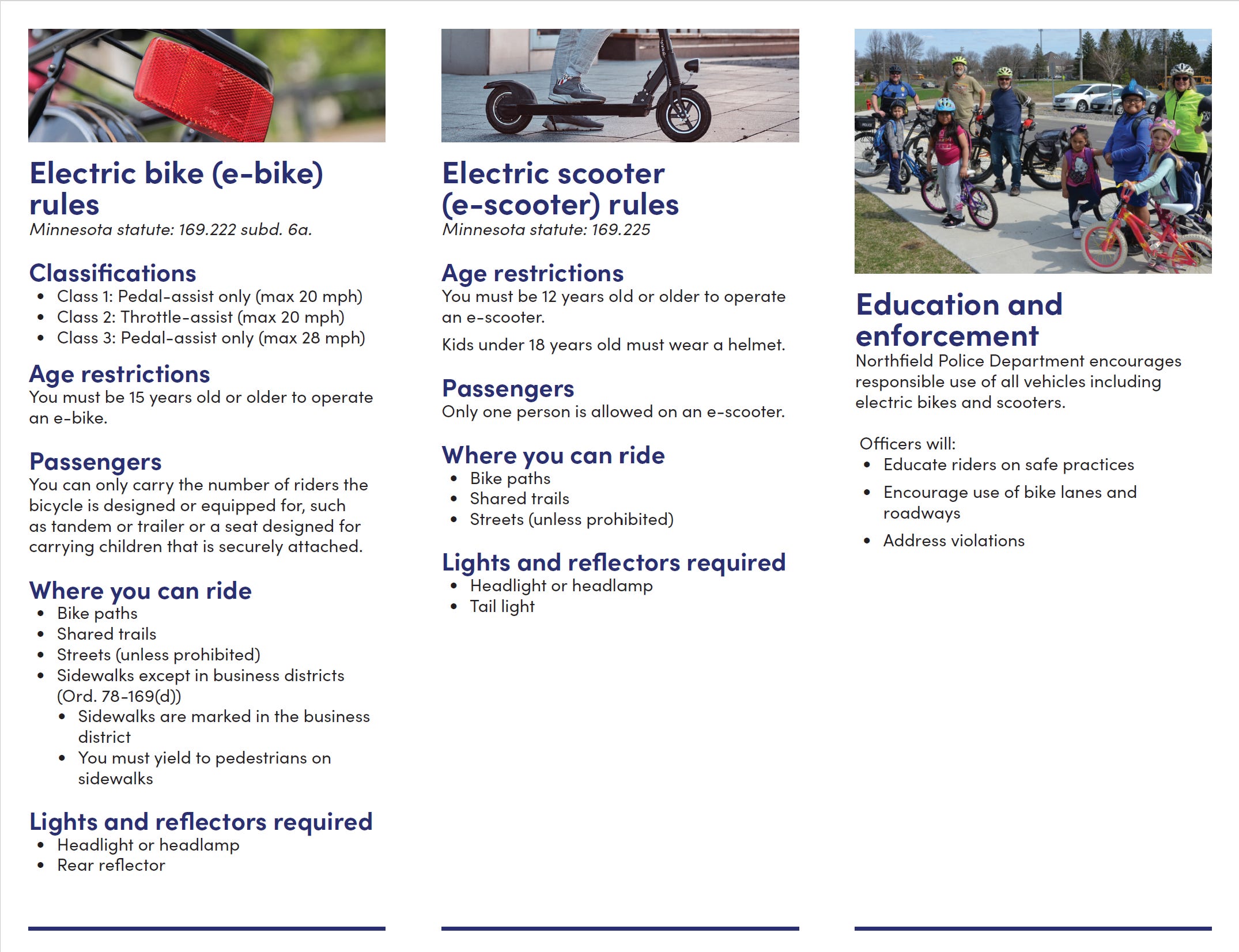
Beyond the brochure, I found one other piece of NPD public education specifically addressing e-motos: a Facebook post from November 21, 2025, ahead of the holiday shopping season.
Consumer Alert: E-Motos Sold as “E-Bikes” in Minnesota
As we head into the holiday season, the Northfield Police Department wants to remind residents to use caution when purchasing electric bicycles online.
Several direct-to-consumer companies are marketing one-, two-, and three-wheeled motorized vehicles as “e-bikes” when, under Minnesota law, they do not qualify as bicycles. These products — often called e-motos — can pose significant safety risks and are illegal to operate as bicycles on Minnesota roadways, trails, and paths.
Before buying, make sure the product meets Minnesota’s legal definition of an e-bike. When in doubt, do your research or reach out for clarification. Your safety — and compliance with state law — matters.
NPD got the classification exactly right here, months before this became a citywide conversation. What’s unclear is why the message wasn’t repeated or built into a sustained effort as e-motos became more visible on Northfield’s trails and sidewalks this spring. Based on NPD's public Facebook and website presence, I found no follow-up to that post.
See the full text of his initial email response to my email in Footnote2.
The Same Week, At City Hall
On the same day I emailed the Chief, Councilor Jessica Peterson White raised the e-moto issue unprompted at a July 7 city council meeting during a discussion of plans for the expanded skatepark. I’ve lightly edited her remarks for clarity:

My follow-up, then, is it seems to me like there’s probably a larger conversation to be had around electric scooters and electric bikes, not just in this park. I’ve certainly heard a lot of concern about this from constituents, with some of these electric scooters and bikes able to go really, really fast. They’re on downtown sidewalks. I was at the pool the other night with my kids, and there were a couple kids riding around on what looked to me to be electric dirt bikes, riding the hills in this park… So I’m just flagging this for staff, not as part of this [skatepark] conversation, but I think it’s time to have another conversation about electric scooters and bikes and their regulation in Northfield.
A Parallel Track: CROCT and the Skills Park
I’ve been tracking this issue since March as one of several volunteers with the local mountain bike club, Cannon River Off-Road Cyclists and Trails (CROCT). We’ve been working with Streets and Parks Manager Andrew Tussing about a city response to the e-motos on the dirt trails and skills area at Sechler Park.
We had a tentative plan in place to post 'no e-moto' signs in the park. Tussing’s July 8 email to the group suggests that decision is now folded into the larger council process rather than moving ahead on its own. See his reply in footnote3.
Pressing on the Ordinance Question
I emailed the Chief to ask whether he had anything to add in response to the comments from Councilor Peterson White and Tussing. When he replied that he could see the city “doing something with an ordinance here, but that takes time,” I pressed him further:
One question on the ordinance piece. Eden Prairie’s bike safety page cites existing MN State Statute 169.223 as the basis for prohibiting e-motos on sidewalks and multi-use trails, without a local ordinance. Is it your position that existing state law doesn’t provide sufficient authority to act in Northfield, or is the education-first approach a choice independent of what the law already allows?
His reply:
Apples and oranges, hence so much confusion with these. 169.223 is for e-motos, thus needs registration and permit or license and cannot be on sidewalk. These are essentially the same as like a moped. E-bikes on the other hand, can be on sidewalks (except downtown). And that’s just the tip of the iceberg, hence so much confusion about them.
Essentially, the Chief confirmed that his department already has the legal authority to cite e-moto riders for operating on city sidewalks and paved trails. His response indicates the department is not currently making citation of these violations its primary response.
My Take
I keep thinking about the fact that Peterson White has watched e-motos ride past her downtown bookstore. Janet Stotko was hit on a quiet neighborhood sidewalk in Hastings, not a busy commercial strip, which suggests the danger isn't limited to downtown. That distinction, between what the law allows and what the department chooses to enforce, matters for what residents can expect if they call 911 to report a violation.
The city doesn't need to wait for an ordinance or new state legislation to start enforcing what's already illegal. I'd like to see the council and NPD treat that as a starting point, alongside a more concerted, multi-faceted public education effort than what exists right now.
Footnotes
My email to Chief Schroepfer, July 7, 8 am:
Hi Jeff, I’m working on a Northfield.org post about e-motos and high-powered e-bikes and would welcome your perspective on what NPD is seeing locally and how the department is approaching it.
The issue is getting significant attention across the metro this summer. Blaine passed a new ordinance in June authorizing confiscation of e-motos. Cottage Grove passed its own ordinance in April. Maple Grove and Eagan have both launched public education campaigns. The common thread is high-powered throttle-driven e-motos being ridden at speed on paved trails and sidewalks, a problem that predates any new state law, since the legislature did not pass new e-bike or e-moto legislation this session.I’d like to understand:
1. Is NPD seeing e-moto or high-powered e-bike complaints or incidents on city paved trails, sidewalks, or streets?
2. Does NPD have a current approach to addressing it, whether education, enforcement, or both?
3. Is the department tracking this as an emerging issue?FYI, this is separate from the issue of e-motos on the CROCT mountain bike trails and skills park in Sechler Park. A group of CROCT members (including me) are working with Andrew Tussing on that issue.
Chief Schroepfer’s reply on July 7, 6:23 PM
Hi Griff, Thanks for reaching out.
Like many communities, we’ve seen an increase in the popularity of e-bikes and e-motos, and with that we’ve received occasional complaints involving their operation. Most of the concerns involve speed, operation on sidewalks or trails, and riders operating in a manner that creates safety concerns for pedestrians and other users.
At this point, I would not characterize it as a widespread problem in Northfield, but it is something we’re aware of and monitoring. As these devices become more common, we expect the number of complaints and enforcement contacts to increase.
Our approach has primarily been education. Last year, the Northfield Police Department developed informational brochures explaining Minnesota’s e-bike laws, safe operation, and where different types of e-bikes may be ridden. Those brochures are available on the City’s website, at the Police Department, and in both English and Spanish. We want to make it as easy as possible for riders and parents to understand the rules before problems occur.
Many of the riders are juveniles, and in many cases parents don’t realize the capabilities of these machines or that some higher-powered models are not legally considered e-bikes. Depending on their speed and design, they may be subject to the same laws and equipment requirements as other motor vehicles (motorcycles). Helping parents understand what they’re purchasing, where these vehicles can legally be operated, and the safety risks involved is one of the most important steps we can take.
When we encounter unsafe operation or violations of existing laws, we’ll take the appropriate enforcement action. However, enforcement alone isn’t the answer. Education—especially for parents and riders—is key to preventing problems before they occur.
I also think this is an area where the Minnesota Legislature should continue its work. The technology has advanced much faster than the laws, creating confusion for consumers, retailers, and law enforcement. Clearer definitions and regulations would help everyone better understand what’s legal, what’s not, and how these vehicles can be used safely.
We’re also paying close attention to what other communities are doing. As you mentioned, several cities have recently adopted ordinances or launched education campaigns, and we’ll continue to watch how effective those efforts are. This is a relatively new issue for all of us. As these devices continue to evolve and become more common, law enforcement, local governments, parents, and legislators will all need to adapt. The challenge is determining what approaches actually improve safety while still allowing people to responsibly enjoy these devices.
Our goal is to support responsible use while ensuring our streets, sidewalks, and trails remain safe for everyone.
Thanks,
Jeff Schroepfer
Chief of Police
Andrew Tussing email to CROCT, July 8:
A little update for everyone. Council has received additional inquiries regarding electric bikes, scooters, and other similar devices. Given these questions, along with the ongoing discussions surrounding e-motos, it is likely that the City Council will consider establishing consistent regulations for what will and will not be permitted throughout the entire parks system. I will keep everyone informed of any upcoming Council discussions on this topic so you have the opportunity to share your knowledge, provide operational insight, and offer feedback on any proposed restrictions before decisions are made. - Andrew Tussing, Streets and Parks Manager
See the latest Northfield.org posts in the archive.
See the recent Quick Take posts here.
Want to keep up with the discussion? Tap the ❤️ on this comment, and Substack will nudge you when there’s activity.
Thanks Griff! I’ve been increasingly alarmed in NoFo with all the kids on motorized bikes & scooters. What is the legal age for motorized bikes and scooters, if at all?
I’ve also seen lots of little kids zooming across Hwy 3 at intersections and nearly getting hit by traffic. Do parents realize that their kids are doing this?
I thought it was verboten to ride bikes and scooters on all city sidewalks—it sounds like only downtown NoFo?
If the police are leaning on education as their main tool, they better up their game otherwise we’re going to end up with what happened in Hastings or worse. What can we citizens do?